Screen Time vs Learning Apps: What the Research Says
"Screen time" gets treated as one big category, as if watching short videos, playing a fast-paced game, and working through a math problem were all the same thing. They are not. Current research is pretty clear that the what matters much more than the how long.
The two kinds of screen time
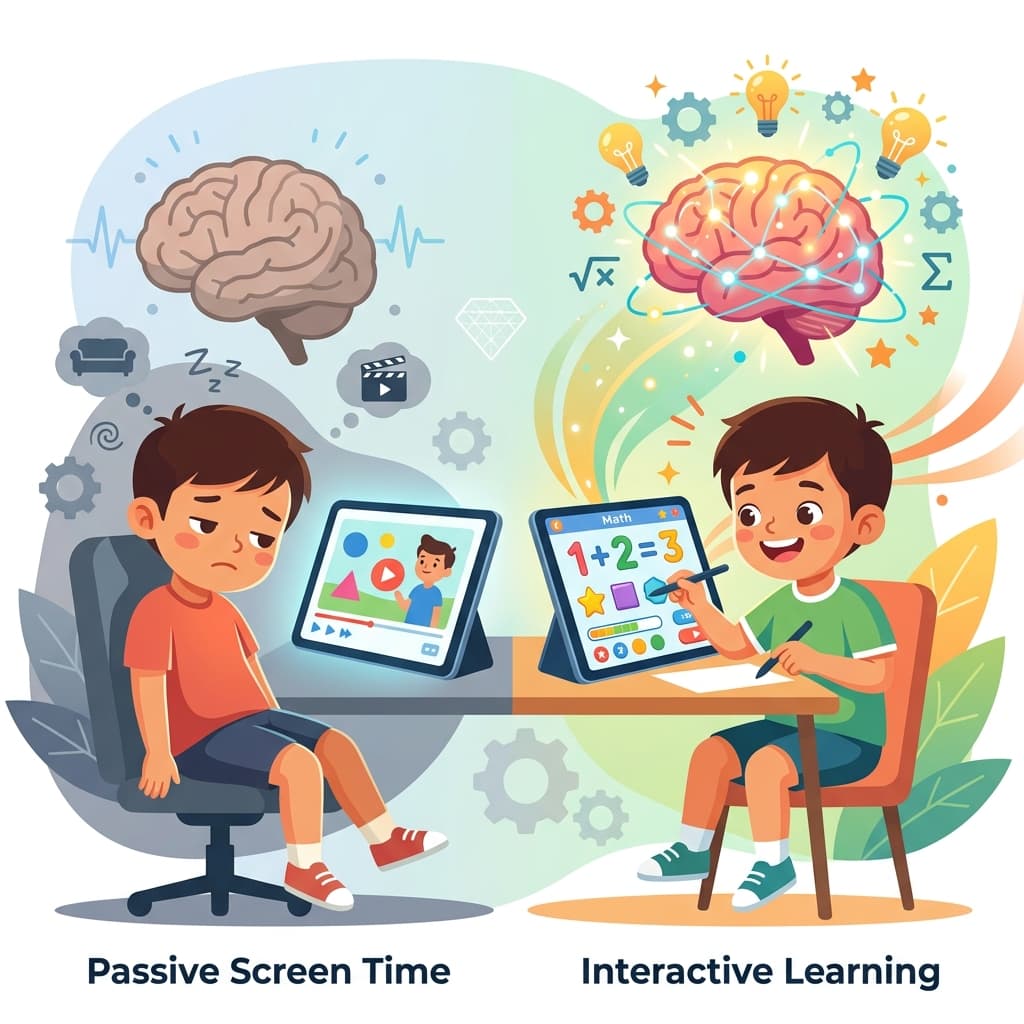
Researchers broadly distinguish between passive and active screen use. Passive use — watching videos, endless scrolling, short-form content designed to hold attention — is the kind associated with the concerning findings most parents have read about: reduced attention span, sleep disruption, decreased reading.
Active use — working through a learning task, solving problems, creating something — looks very different on almost every measure. The brain is engaged, the task has a goal, and the child has to think. The harms researchers worry about do not show up in the same way.
What makes a learning app actually educational
- It asks the child to think. Good learning apps put the child in the producer seat, not the consumer seat. They answer questions, solve problems, make choices.
- It is adaptive. An app that serves the same content to every child will bore some and overwhelm others. Good apps meet the child where they are.
- It has clear goals. "Practice multiplication facts for fifteen minutes" is a goal. "Keep scrolling" is not. Learning apps should have obvious starting and stopping points.
- It does not use dark patterns. Autoplay, endless streaks that punish missing a day, loud rewards designed to trigger dopamine hits — these are the hallmarks of apps built to maximize screen time rather than learning. Walk away from any app that uses them.
- Parents can see progress. A real learning app shows you mastery per topic, not just a meaningless "level." You should be able to tell, at a glance, what your child has learned this week.
How to think about time limits
Rather than a blanket screen-time cap, think about it as a budget split between passive and active use. Fifteen to thirty minutes of focused, active learning most days is time well spent for elementary kids. An hour of short-form video is not the same thing, even though it is also "screen time."
The practical test: does your child come away from the session calmer or more wound up? Did they learn something they can show you? If the answers are "calmer" and "yes," the app is probably doing its job.
Ready to see adaptive math practice in action?
Start Free Trial